

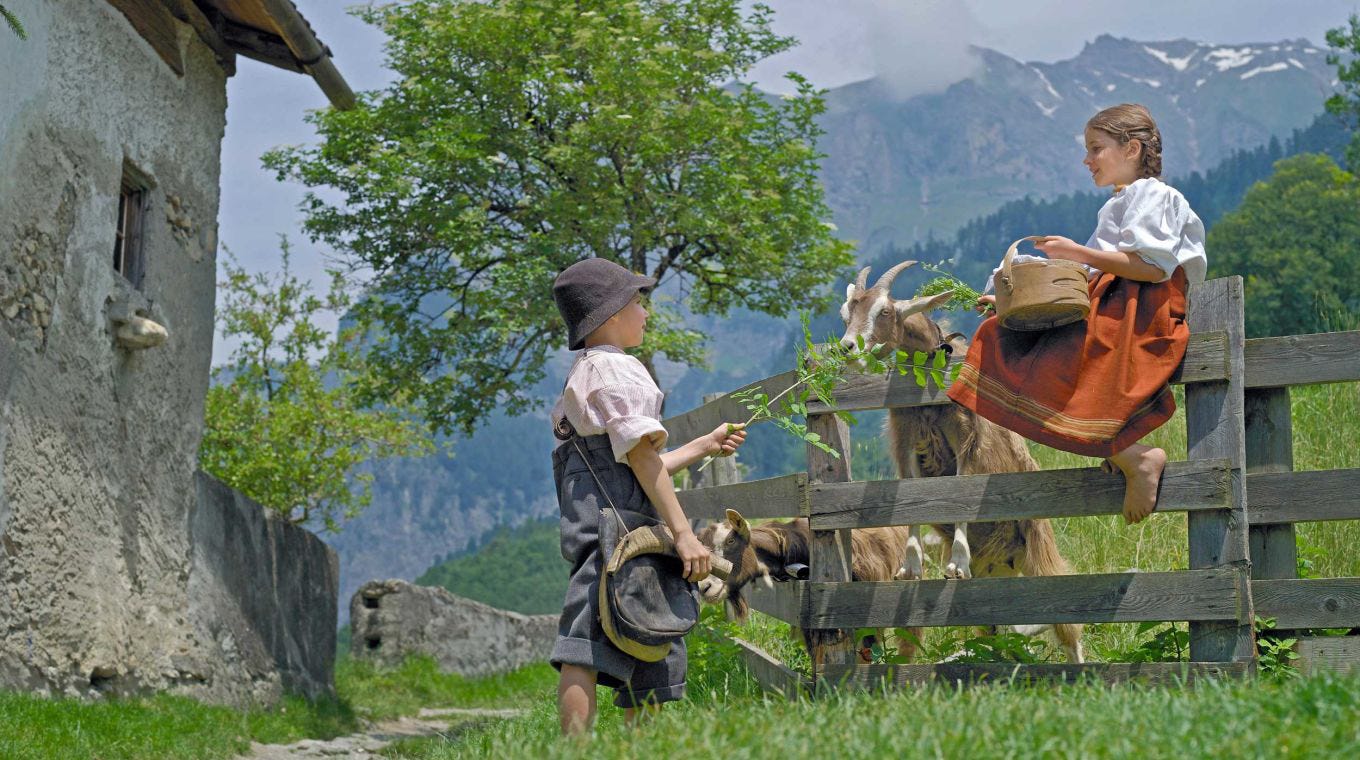
Christopher: You’ve been reading Heidi? But that’s a children’s book isn’t it?
James: It is. It was written by Johanna Spyri in 1880 and has sold over 50 million copies. Not quite Harry Potter, but certainly up there with Anne of Green Gables and Benjamin Spock’s The Common Sense Book of Baby and Child Care. It’s considered a classic, and I was curious…
Christopher: Really?!? Oh, okay. So, um, what’s it about?
James: Well, it’s about Heidi, who’s an orphan and lives with her grandfather in the Swiss Alps, but then is taken to Frankfurt to be a companion for Clara, who is an invalid and can’t walk. But Heidi is homesick and eventually is allowed to go back to the mountains. But Clara misses her and comes to visit and while she is there she gets better and can walk again.
Paper Plus describe it as a heart-warming tale of a small girl’s power for good.
Christopher: And how would you describe it?
James: I think, if I were a small girl reading it, I’d find her a bit of a pain, actually. She’s so nice: “Heidi herself was never bored because she always saw something new and exciting to take up her attention”and (mostly) so good: “Heidi obeyed at once.” And the preaching would bother me too: “God is our Heavenly Father and always knows what is best for us.”
But it was written in 1880 and—according to the British Library—those who write children’s books have always thought it part of their job to instruct their readers, whether in facts, religion, morals, social codes, ways of thinking, or some other set of beliefs or ideas.1
Christopher: A book of its time, then?
James: Absolutely. And that’s what I started thinking about. Because the over-riding message of the book is that cities are bad and the countryside is good. “The days went by and Heidi could never tell whether it was winter or summer, for all she ever saw of the outside world were the same grey walls and roofs” versus “a beautiful green pasture with all sorts of animals grazing. In the midst, the shepherd leant upon his stick and looked happily at his flock. Everything was bathed in a golden light for the sun was just setting on the far horizon.”
We know that cities in the 19th Century were not great places: they were getting too big, too fast. In 1800 the population of Frankfurt was 35,000. Just eighty years later, when Heidi was written, it was four times that. Here’s a description of Wellington, New Zealand at about that time:
In these poor areas2, the small backyards became ‘the receptacle for all liquid and other slops of each dwelling, and as they are closely packed [and] inhabited by two or three families of ten or twelve souls upwards, the land became saturated, exhaling the most poisonous vapours’.3
In addition to smallpox, typhus, yellow fever and scarlet fever, cholera emerged: worldwide there were six major cholera pandemics in the 19th Century4. No wonder Johanna Spryi idealised the countryside…
Christopher: Is that why Clara was ill?
James: In a way. I was curious about her being able to walk again after some time in the Alps—if she were paralysed, surely no amount of mountain air would cure her—and, after consulting Dr Google, I concluded she was probably suffering from rickets, a painful softening of the bones; increasingly common in the 19th Century as society urbanised. Rickets is caused by a lack of Vitamin D and the treatment is sunshine and calcium5. When Clara left overcrowded Frankfurt to visit Heidi in the Alps, she was not only outdoors, but lapping up goats milk and scoffing cheese.
Christopher: And so, the moral is, go live in the mountains?
James: I’ve no doubt Johanna Spyri thought so. When she writes about where Heidi is from, she’s actually describing where she herself was from: a small town in a bucolic region near Lake Zurich. And I expect the tourists who visit Heidi Village6 in Maienfeld, likely think so too.
But that’s unrealistic. Not only is urban growth unstoppable (Frankfurt’s population is now over 800,000. By 2050 around 70% of people will live in cities7) but many experts believe cities offer the best prospect of a low-carbon future8.
Visiting the mountains and changing her diet helped Clara get well, but she wouldn’t have become sick in the first place if she’d had a better diet and Frankfurt had been better prepared for a burgeoning population.
Christopher: So, what about Wellington, then?
James: Interesting, because New Zealand’s answer to urban squalor was suburbia. In 1937, the first state house was built, in Miramar. The opposition argued that they should be building central city flats, but the response was…
that flats do not provide sufficient light or sufficient ventilation, and, generally speaking, they are undesirable for the housing of growing families. I much prefer the method of the Government of building houses in the outer suburbs where a family has some privacy, where the father can have a garden to grow some vegetables and where the children can play, instead of having to play on city streets or remain indoors all day long as they have to when living in flats.9
The New Zealand dream: kind of the Swiss Alps, only in Naenae. Because cities in the 1800s were so bad, in the 1900s New Zealand built suburbs and motorways, and now, in the 2000s, we’re solving the problems our previous solutions left us with.
Christopher: so that’s Heidi then?
James: I guess so. Someone10 wrote: Books and doors are the same thing. You open them, and you go through into another world.
So I’ll leave you this, from Heidi’s grandfather…
That’s what the sun does when he says goodnight to the mountains. He throws his beautiful rays over them so they won’t forget him before morning.
Heidi Hi.
https://www.bl.uk/romantics-and-victorians/articles/moral-and-instructive-childrens-literature
Te Aro
From the Evening Post, November 1877, quoted (p538) in Empire City by John E. Martin.
https://en.m.wikipedia.org/wiki/Diseases_and_epidemics_of_the_19th_century
https://www.healthnavigator.org.nz/health-a-z/r/rickets/
https://www.heididorf.ch/en/welcome/heidis-village/
https://ourworldindata.org/urbanization#:~:text=By%202050%2C%20global%20population%20is,rural%20settings%20(3.1%20billion).
https://www.weforum.org/agenda/2020/01/smart-and-the-city-working-title/
https://nzhistory.govt.nz/culture/we-call-it-home/the-state-steps-in-and-out
Jeanette Winterson, an English writer.
Like I said…curious about a classic. I tried to read Don Quixote once, but couldn’t go the distance. Everyone talks about him charging at windmills but that was very early in the book, so perhaps they didn’t get far either. Has anyone in the past hundred years or so read the whole thing? At least I finished Heidi.
Thank you for the modern & detailed explanation. I can remember feeling quite ‘not nice’ when reading this as a child. How to match such joyful duty 🙄
And for making it way more funny than it ever was.
BUT - what were you doing reading this book!?